
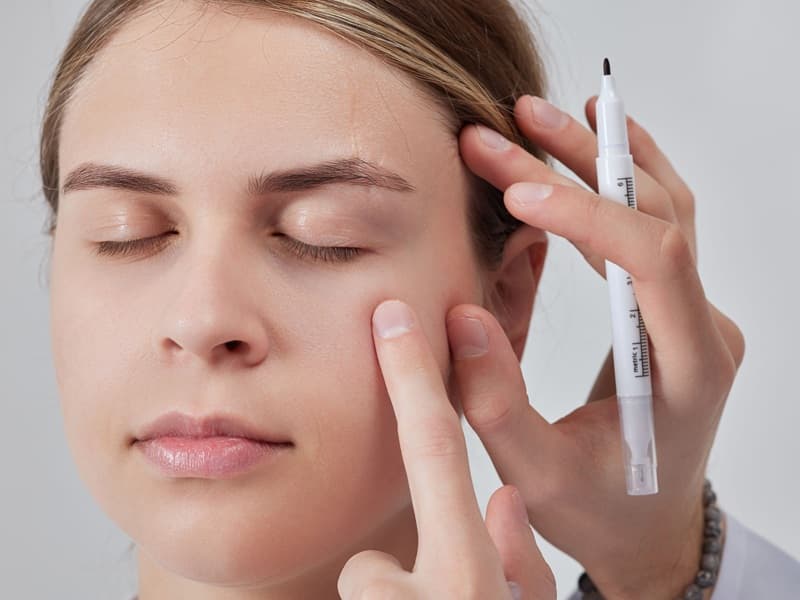
Ptosis surgery in Amsterdam by a BIG-registered ophthalmologist
From €1.270,50· ptosisoperatie, één oogSee all prices
A drooping upper eyelid is rarely only a cosmetic matter. Once the eyelid margin covers the pupil, visual field is lost. Ptosis surgery in Amsterdam by an ophthalmologist who assesses the lifting muscle, the visual field and the ocular surface together — in English.
What is ptosis?
Ptosis is a drooping upper eyelid. The eyelid margin sits lower than it should because the eyelid-lifting muscle — the levator palpebrae superioris — is not delivering enough force, or because that muscle's tendon has detached from the tarsal plate.
The consequence is not only a tired or asymmetric appearance. In pronounced ptosis the eyelid margin covers part of the pupil and visual field is lost, particularly upward. Many people compensate without noticing, by raising the eyebrow or tilting the head back, which in time produces neck and headache complaints.
Ptosis or dermatochalasis?
These two are constantly confused, and the treatments differ fundamentally.
- With ptosis, the eyelid margin itself sits too low. The problem is in the muscle. The treatment is ptosis surgery, repairing or shortening the levator.
- With dermatochalasis, the eyelid margin is at the correct height but too much skin hangs over it. The problem is in the skin. The treatment is eyelid surgery.
They regularly occur together. If only skin is removed in that case, the eyelid opening stays too small and the patient is rightly dissatisfied. A correct diagnosis before surgery determines the outcome.
Causes of ptosis
- Involutional ptosis. By far the most common. The levator tendon stretches or detaches from the tarsal plate, usually later in life. The lid drops while the muscle itself still works well.
- Congenital ptosis. Present from birth, from incomplete development of the levator. In children this needs prompt attention, because a covered pupil can impair visual development.
- Mechanical ptosis. The lid is pulled down by weight, for instance a swelling or scar tissue.
- Neurogenic ptosis. From a disturbance in nerve supply, such as a third nerve palsy or Horner's syndrome.
- Myogenic ptosis. From a muscle disease, including myasthenia gravis, where the ptosis characteristically varies through the day.
- Traumatic ptosis. After an accident or previous eye surgery.
Ptosis that appears suddenly, varies during the day, or comes with double vision or an abnormal pupil requires further investigation first. These can indicate a neurological or systemic cause that must be resolved before any surgery is considered.
Assessment before surgery
The technique follows from the measurement, not the other way around. At consultation Dr. Kloos assesses:
- 1.Eyelid height. The distance between the eyelid margin and the light reflex on the pupil, known as the margin reflex distance. This records objectively how low the lid sits.
- 2.Levator function. How many millimetres the lid travels between full up-gaze and down-gaze with the brow held still. This determines which technique is appropriate.
- 3.The eyelid crease. A high or absent crease points to a detached levator tendon.
- 4.Tear film and lid closure. An eyelid that sits higher after surgery closes less easily. In a dry eye, that calls for restraint.
- 5.Visual field. Where the question is medical, a visual field test records the restriction objectively — which your insurer will also require.
The surgical techniques
Which technique is used depends on the remaining function of the levator.
Levator advancement or resection
For reasonable to good levator function, which is usually the case in involutional ptosis. Through an incision in the eyelid crease the levator tendon is located and reattached, or shortened, to the tarsal plate. The scar coincides with the natural crease.
Frontalis suspension
For very weak or absent levator function, as in pronounced congenital ptosis. The eyelid is connected to the forehead muscle with a suspension material, so the lid is raised with the brow.
Surgery is performed under local anaesthesia and takes 60 to 90 minutes per eye. Being awake is an advantage here: you may be asked to open your eyes during the procedure so height and symmetry can be checked seated and adjusted if needed.
Recovery
- Day 0 to 3. Swelling and bruising, worst in the first days. Cooling helps.
- Day 5 to 7. Sutures are removed at your check-up.
- Week 2 to 4. Swelling continues to settle. The lid may still look slightly high or low at this stage; that is normal and not yet the final result.
- Week 6 to 12. The position stabilises and the scar fades.
Expect the eyelid to close less completely in the first weeks. Artificial tears, or ointment at night, are often needed in that period. Where one eye is operated on, a small height difference with the other may remain visible; this is discussed at consultation.
What this costs, and insurance
Ptosis surgery is priced per eye, because one side is often treated. Our prices are published and include consultation and follow-up.
Unlike a purely cosmetic eyelid correction, ptosis surgery with a demonstrated visual field restriction is more likely to qualify for reimbursement from Dutch basic health insurance (basisverzekering). Your insurer assesses each case, generally on the basis of a visual field test and a referral from your GP. If you are new to the Netherlands, that referral — from your huisarts — is the usual starting point, and we explain the authorisation and billing route on our insurance and billing page.
Why an ophthalmologist
Ptosis surgery is millimetre work on the muscle that opens and protects the eye. Correcting a few millimetres too much means an eyelid that no longer closes properly, risking dryness and corneal damage. A few millimetres too little means a lid that still droops, and a second operation.
Dr. Kloos is a BIG-registered ophthalmologist — the Dutch government register of qualified healthcare professionals — with oculoplastic specialisation, and assesses eyelid position, muscle function and the condition of the ocular surface together. Where findings point to a neurological or muscular cause, investigation comes first and surgery does not.
Consultations in English, in Amsterdam
Skin & Vision Clinic is at Louwesweg 6k in Amsterdam. At your consultation the measurements are taken, the cause of the ptosis is established, and Dr. Kloos explains which technique suits your situation, with a transparent quote. Consultations are held in English and patient information is available in English.
What does ptosis surgery cost in Amsterdam?
- Ptosisoperatie, één oog
- €1.270,50
- Ptosisoperatie, beide ogen
- €2.238,50
Includes consultation and follow-up. Indicative prices — you receive a personal quote at your consultation. See all prices or read more about insurance and billing.
Frequently asked questions about ptosis surgery
Do I need to speak Dutch for a consultation?
+
No. Consultations are held in English and patient information is available in English.
Is ptosis surgery covered by Dutch health insurance?
+
With a demonstrated visual field restriction, ptosis surgery is more likely to qualify for reimbursement from Dutch basic insurance than a cosmetic eyelid correction. Your insurer assesses each case individually, generally on the basis of a visual field test and a GP referral.
What is the difference between ptosis and dermatochalasis?
+
In ptosis the eyelid margin itself sits too low because the levator muscle underperforms. In dermatochalasis the margin is at the correct height but excess skin hangs over it. The treatments differ fundamentally, and the two regularly occur together.
Is one eye or both eyes operated on?
+
It depends on the findings. Ptosis is often one-sided, which is why we price per eye. Where one side is treated, a small height difference with the other eye may remain visible; this is discussed at consultation.
Can ptosis surgery need to be redone?
+
A correction of a few millimetres too much or too little can warrant a second procedure. That is why eyelid height and levator function are measured beforehand, and why height is checked with you seated and awake during surgery under local anaesthesia.
Can ptosis resolve on its own?
+
Involutional ptosis, the most common form, does not resolve and gradually progresses. Ptosis that varies through the day, appears suddenly, or comes with double vision needs investigation for an underlying neurological or muscular cause first.
What does ptosis surgery cost?
+
EUR 1,270.50 for one eye and EUR 2,238.50 for both, including consultation and follow-up. All prices are published on our pricing page.
- Medical & cosmetic indications
- May be covered by insurance
- Local anaesthesia
- BIG-registered ophthalmologist
- Duration: 60–90 minutes per eye
- Recovery: 4–6 weeks full recovery
Questions about this treatment?
Dr. Kloos will gladly discuss your wishes and options during a personal consultation.